
Turkish Sephardic Cuisine
THE SEPHARDIC CUISINE IN TURKEY
A 500-Year-Old Culinary Heritage in Anatolia
In 1492, following the Spanish Inquisition, the Catholic monarchs Ferdinand of Aragon and Isabella of Castile ordered all Jews and Muslims in Spain to either convert or leave the country. Nearly 200,000 Jews were exiled. Many found refuge in the Ottoman Empire, where Sultan Bayezid II welcomed them, recognizing the knowledge, skills, and craftsmanship they brought.
These Jewish communities settled primarily in Istanbul, the Aegean region, Thrace, and the Balkans. In Hebrew, Spain is called Sefarad, and the Jews who came from there called themselves Sephardim. Their culinary traditions became known as Sephardic cuisine — a rich blend of Iberian heritage and Ottoman flavors.
A Cuisine of Migration and Adaptation
Sephardic cuisine cannot be defined by a single region. As Sephardim migrated — sometimes through France, Italy, and the Balkans before reaching Ottoman lands — they adapted to local ingredients, cooking techniques, and tastes. Yet they preserved their Iberian roots and religious traditions.
Unlike ghettos in other parts of Europe, Jewish communities in the Ottoman Empire lived in their own neighborhoods by choice, not by force. Cultural interaction was natural and constant. Jews, Greeks, Armenians, and Muslim Turks exchanged recipes, techniques, and festive foods. Stories tell of neighbors visiting one another during religious holidays, sharing sweets, savory dishes, and celebrations.
Recipes were passed down from mother to daughter, forming a culinary treasury that survived for centuries.
The Essence of Sephardic Cooking
Two major influences define Sephardic cuisine in Turkey:
-
Spanish-Iberian heritage
-
Ottoman and broader Mediterranean culinary culture
Sephardic cooking is deeply seasonal, resourceful, and vegetable-focused. Historically, meat was expensive, so vegetables were used creatively and completely — even their peels.
Vegetable Dishes
Some iconic examples include:
-
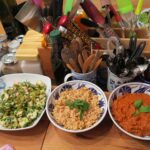
Kashkarikas – A cold dish made from squash peels, dressed with olive oil, lemon, and dill.
-
Red Beet Leaf Pie – Chopped beet greens baked with cheese, eggs, and breadcrumbs into a nourishing savory pie.
-
Armi de Tomat – A summer tomato and rice stew with onions and parsley; a distinctly Sephardic dish not w
-
idely found in mainstream Turkish cuisine.
And of course, the undisputed king of summer vegetables:
The Aubergine (Eggplant)
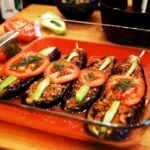
Both Sephardic and Turkish cuisines celebrate aubergine in countless forms — fried, stuffed, baked, or turned into pies.
Spanish empanadas evolved into borekas or borekitas, borrowing the Turkish word börek. A tapada is a tray-baked pie filled with vegetables — especially aubergine — showcasing Iberian roots with Ottoman influence.
Meat and Koftes
When meat appears, it is often minced and transformed into flavorful meatballs.
The most beloved example is:
-
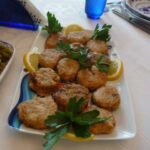
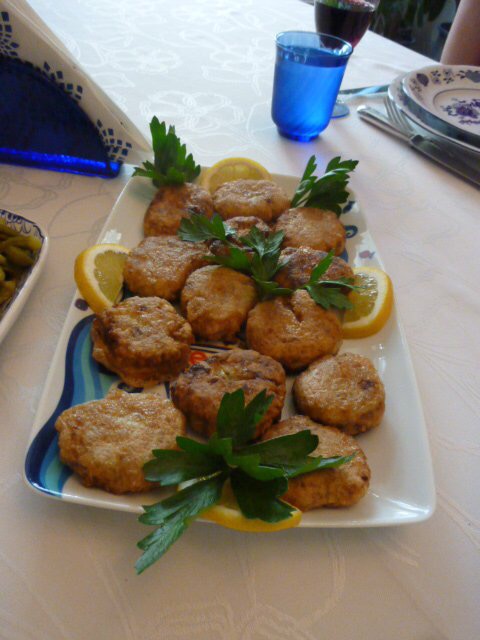
Koftes de Prasa – Leek meatballs, one of the signature dishes of Turkish Sephardic cuisine.
Beef and lamb are grilled, baked,
or stewed with vegetables and spices. Nothing is wasted — the cooking juices are reused to flavor rice, pasta, or vegetables.
The Love of Sour Flavors
One of the most distinctive characteristics of Sephardic cooking is its use of sour sauces — especially lemon.
Vegetables such as okra, artichokes, spinach, and cabbage are often cooked with generous amounts of lemon, more so than in mainstream Turkish cuisine.
A particularly iconic dish is:
-
Gaya kon Avramila – Fish in sour plum sauce, a hallmark of contemporary Sephardic cooking.
Hidden Jewish Influences in Turkish Cuisine
Even some well-known Turkish ingredients may carry Sephardic connections.
The popular cheese kaşar, enjoyed throughout Turkey today, is believed by some scholars to have linguistic ties to the Ladino word kaşer (kosher), brought by Jews from Spain.
Sweet Traditions
Sephardic cuisine is also rich in sweets and preserves.
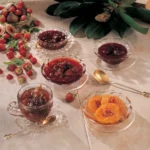
Spain’s famous quince paste (membrillo) lives on as:
-
Helva de Bimbriyo (quince paste)
- Tezpishti
These desserts reflect centuries-old Iberian traditions preserved in Ottoman lands.
A Living Heritage at Risk
Over generations, Sephardic culinary traditions evolved, adapted, and blended with surrounding cultures. Yet modern lifestyles and migration have led to their gradual disappearance.
Today, preserving and sharing these recipes is more important than ever. They are not only dishes — they are stories of exile, resilience, cultural exchange, and coexistence.
SEPHARDIC CUISINE RECIPES
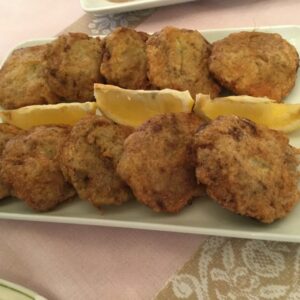
ALBONDIGAS de PRASA– Leek Patties
Ingredients:
1,5 Kg. of leek
250 gr. of minced meat
4 eggs
Salt, pepper
Preparation
Peel the leeks, wash them well, chop and boil them until they are very soft. After they are boiled press them between your palms as hard as you can to get all the water out This is very important in order to make the meatballs firm. Now put the leeks into the food processor and blend to a soft paste. Then mix together the soft leek paste, minced meat, 2 egg yolks, salt and pepper.Shape into little round flat cakes of about 4-5 cm wide and dip them in to flour on a plate. Dip each in to beaten egg and lower gently into sizzling oil. Lower the heat, so as not to brown them too quickly, and turn over once. Drain on paper towels and serve hot
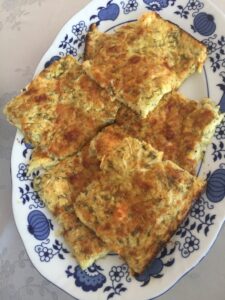
ALMODROTE de KALAVASA – Zucchini Flan
Ingredients
2 kg of zucchini
4 tablespoons of flour
2 eggs
4 table spoons of olive oil
100 g white (feta) cheese
150 g grated kasher cheese or gruyere
A bunch of dill
Salt
Preparation
Peel and grate the zucchini. Press with your hand to squezze out as much of the juices as you can.
Add the bread, mashed white cheese, grated kasher cheese ,finely chopped dill, eggs, salt and oil.Mix well.
Pour the mixture into an oiled baking dish,sprinkle the top with some more grated cheese and bake at 180 C
For 45 minutes to 1 hour,until lightly colored.
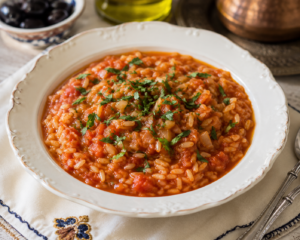
ARMIKO DE TOMAT – Tomato Stew
Ingredients
2 kg very ripe tomatoes
2 onions
2 ½ tablespoons rice
1 tablespoon sugar
4 tablespoons olive oil
1 bunch of parsley
Salt
Preparation
Chop onions and sautée in oil. Peel the tomatoes ,chop them add to onions. Cover and cook both over a small flame.
When boiling add salt, sugar ,rice and chopped parsley . If tomatoes not juicy you can add little water.
Cover and continue to cook over small fire.Ready when rice is cooked.
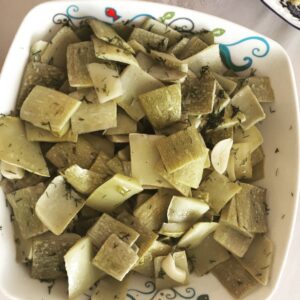
KASHKARiKAS – Zucchini peels in sour sauce
Ingredients
1.5 kg zucchini
1 small cup of olive oil
1 teaspoon sugar
Juice of 1 ½ lemon
2-3 cloves garlic
A few sprigs of fresh dill
Salt&Pepper
Water
Preparation
First slice off the peel from the zucchini in long, thick ½ cm slices. Then cut them in 3-4 cm squares.
Lighly boil the zucchini peel in water for a few minutes. Add lemon juice, garlic, dill, salt, pepper, sugar and enough water to cover. Cook over a small flame until all the water is gone. Cover and refrigerate. Serve cold .
 BOREKAS DE BERENCENA -Eggplant Borekas
Ingredients
Filling
* 2 large eggplants
* 100 g feta or Turkish beyaz peynir
* 100 g grated kaşar
* Salt, very little if the cheeses are salty
* Optional: a little black pepper
Pastry
* 5–6 sheets phyllo (filo), or 2 large Turkish yufka
* About 60–70 g melted butter, or a mixture of butter and olive oil
* 1 egg yolk + 1 tbsp milk for brushing
Preparation
Roast the whole eggplants until completely soft and smoky. Peel them, then leave the flesh in a strainer until very well drained. This is important—the filling must not be watery.
Mash the eggplant very finely, almost to a purée. Mix with the crumbled white cheese and grated kaşar. The original Turkish Sephardic recipe uses exactly this combination of roasted eggplant, white cheese and kaşar.
If using thin packaged phyllo, I would use 2 sheets together for each batch, lightly brushing between them with melted butter. Cut into long strips. Put a narrow line of eggplant filling along the long edge, keeping the filling inside rather than exposed.
Roll gently into a long tube, then curl the tube around itself to make a small rose/spiral.
Place seam-side down on a baking tray. Brush very lightly with egg yolk and milk.
Bake at 180°C for approximately 25–30 minutes, until beautifully golden and crisp.
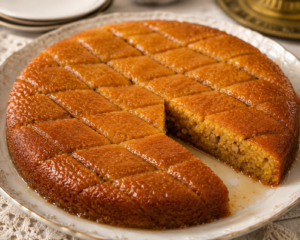
TEZPISHTI ( meaning cooked rapidly in Turkish )
Ingredient List
4 eggs
250 gr sugar
420 gr matzot flour or flour
500 gr coarse ground walnuts
10 gr baking powder
1 orange –juice and zest
200 gr olive oil
SYRUP
300 gr sugar
375 gr water
Juice of half a lemon
Preparation
Beat the eggs and add the sugar.The add flour and continue to mix. Add walnuts, baking powder, zest of orange and the sunflower oil and bake at 180 c oven 25 minutes. Do not forget to put some oil on the oven tray you are going to use. Meanwhile prepare your syrup and let it cool .
When you take out your cake pour 200 ml lukewarm water and then the cool syrup over it and wait for the cake to cool before serving.( about 1 hour